
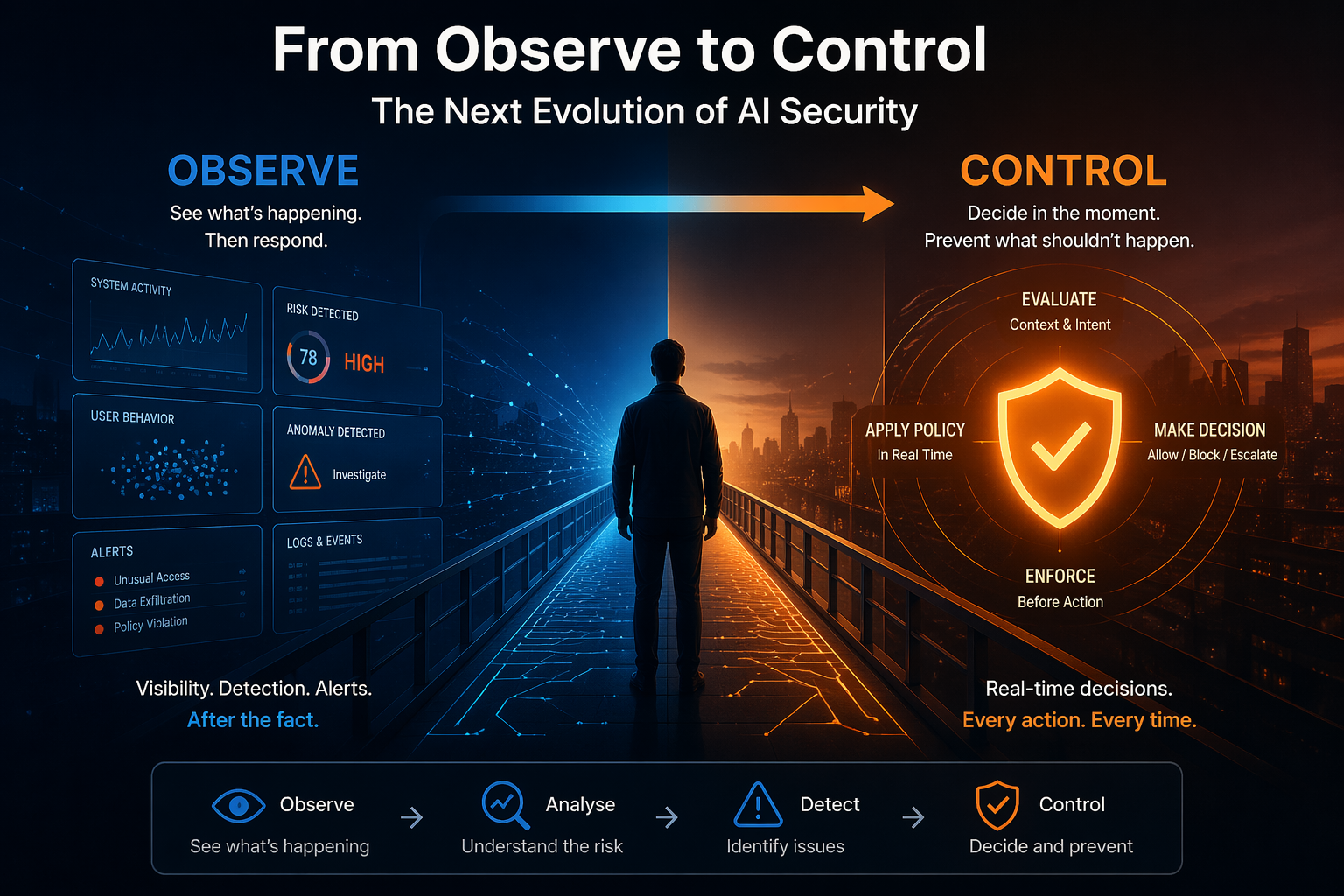
From Observe to Control: Why AI Security Needs a New Operating Model
For years, security has operated on a simple premise:
see what’s happening, then respond.
We’ve built entire platforms around that idea. We collect signals, correlate events, surface anomalies, and investigate incidents. Visibility became the foundation of modern security—and for a long time, it worked.
It worked because the systems we were protecting moved at a pace humans could understand, review, and intervene in.
But that assumption is starting to break.
AI doesn’t just assist decisions anymore—it makes them
What’s changing isn’t just the volume of activity. It’s the nature of it.
AI systems are no longer passive tools sitting behind a user interface. Increasingly, they’re acting on our behalf—accessing data, triggering workflows, interacting with other systems, and making decisions that have real consequences.
And they’re doing it at a speed and scale that doesn’t leave room for human oversight.
This is where the tension starts to show.
Because while AI has accelerated, security—at its core—has not.
The real problem isn’t visibility
If you spend time with security leaders right now, you’ll notice something interesting. The conversation has moved on from visibility.
It’s no longer, “Do we understand what’s happening?”
It’s closer to, “Are we actually in control of it?”
That’s a very different question.
Most organisations already have a reasonable view of their AI systems. They can see behaviour. They can analyse patterns. They can even detect when something looks wrong.
But all of that happens after the fact.
And with AI, after the fact is often too late.
We’ve built security to observe—not to decide
The way most security tooling is designed reflects the world it came from.
It assumes there’s time to review a risk score, to triage an alert, to investigate an anomaly before taking action. It assumes that when something important happens, a human will be somewhere in the loop.
That model doesn’t hold when systems are acting autonomously.
Because AI doesn’t wait for approval. It doesn’t pause while a dashboard is checked or a ticket is raised. It simply executes.
Which means the most important moment—the one that determines whether something is safe or risky—passes before traditional security has a chance to intervene.
The moment that matters most
Every AI system has a critical point: the moment it decides to act.
It might be returning a piece of sensitive information. It might be triggering a financial transaction, calling an external service, or initiating a workflow deep inside an organisation’s infrastructure.
In that moment, everything comes down to a single question:
Should this be allowed to happen?
Not in hindsight. Not after analysis. Right then.
And for most organisations today, there isn’t a clear answer.
This is where security needs to evolve
What’s needed isn’t more data or more alerts. It’s a shift in how decisions are made.
Security needs to move closer to the action itself. It needs the ability to evaluate intent, apply policy, and make a decision in real time—before anything actually happens.
This is the transition from observing systems to controlling them.
It’s a subtle shift in language, but a profound shift in capability.
Observing tells you what is happening.
Controlling determines what is allowed to happen.
Control changes the role of security
When you introduce control at the moment of action, security stops being purely reactive.
It becomes something that can enforce outcomes consistently, at scale, and at the same speed as the systems it’s governing.
Policies are no longer guidelines that are reviewed after an incident. They become something that is applied continuously, shaping behaviour in real time.
Decisions are no longer something you analyse after they’re made. They’re something you govern as they happen.
And accountability becomes much clearer, because every action can be traced back to a decision that was explicitly allowed, blocked, or escalated.
This isn’t about replacing what we have
Everything that exists today—posture management, data security, model protection, threat detection—still plays a critical role.
These capabilities help us understand risk, identify weaknesses, and respond when things go wrong.
But they weren’t designed to answer the question of whether an AI system should act in a specific moment.
That’s the gap that’s emerging.
And it’s not a failure of the existing stack. It’s simply a reflection of how quickly the nature of systems is changing.
The next phase of AI security
As AI becomes more autonomous, the demands on security will continue to evolve.
We’ll need systems that can operate at machine speed, because that’s where decisions are now being made. We’ll need governance that is continuous, not periodic. And we’ll need enforcement that happens in real time, not after the fact.
In other words, we’ll need security that doesn’t just observe.
It will need to decide.
Final thought
For a long time, security has been defined by what we can see.
But in a world of autonomous systems, that’s no longer enough.
The organisations that will succeed are the ones that can go a step further—
not just understanding what their AI is doing, but controlling it at the moment it matters most.
Because as innovation moves to machine speed, security has to move with it.